by Lawrence Bywater | Feb 4, 2013
The 2009 Milan San-Remo. A warm sunny day awaited the 200 riders of the 100th edition of La Primavera. Amongst those on the startlist, including Andy Schleck, Bradley Wiggins and eventual winner Mark Cavendish, was the quasi Australian Heinrich Haussler. What happened in the preceding 7 hours has been retraced many times since. The coming of age of Cavendish at the tender age of 23 was obviously headline news. Haussler’s second place on the day, inches away from a first classic, rightly remained the subplot.
One day wins can define a career. Fred Guesdon is known for his triumph in Paris-Roubaix of 1997 and arguably the same fate may yet befall Johan Van Summeren who also triumphed in the hell of north in 2011. So, on the via Roma of San-Remo, in the dull sun of an April Sunday, had Heinrich Haussler’s missed the chance to define a his cycling life. Born to a German father and an Australian Mother, Haussler remained in New South Wales, Australia until 1988, when he moved to Germany to pursue a career as a pro cyclist.
His breakthrough year in the pro ranks occurred in 2005 as he won a stage of the Vuelta. Beating Pablo Lastras and Linus Gerdemann and others from a small breakaway on a rolling stage 19 he showed tactical nouse by allowing Martin Elmiger to lead him out to catch Juan Manual Fuentes just before the line. The following years, 2006, 2007 and 2008 remained barren years with sparks of success such as top ten’s at the Tour and Gent Wevelgem.
Yet it was 2009 when the stars aligned for Haussler as he didn’t finish outside the top 10 in all stages of the Tour of Qatar and won two stages of the Tour of the Algarve in the early season. Stages at Paris Nice and the Tour de France followed, yet it was in the Spring Classics that he really hit a purple patch. 4th at Dwars Door Vlaanderen, 2nd at Flanders and 7th at Paris Roubaix and at Milan San Remo, Haussler caught Cavendish by surprise, sprinting from over 500 metres to go, coming within a whisper of the greatest win of his career.
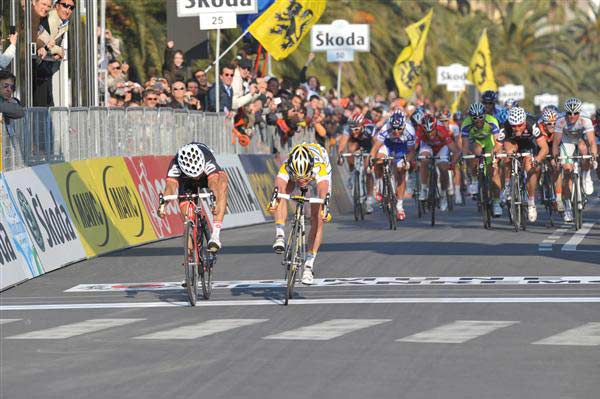
Mark Cavendish pips Heinrich Haussler by a bike throw at the 2009 Milan San-Remo
The jubilant Cavendish hugging Erik Zabel whilst the Australian collapsed to the ground, meters after the finish line could not have been more of a juxtaposition. So what made the difference that year? His growing experience as a fifth year pro, the switch in outfits from Gerolsteiner to Cervelo and an experienced team behind him or a winter of perfect preparation. Whatever the reason, it was clear that Haussler was making a jump to the upper echelons of the sport.
Yet a number of factors kept and continue to keep Haussler at bay. The difficult marriage of Cervelo and Garmin after the former removed their sponsorship at the end of 2010 meant he was now competing for leadership with Thor Hushovd amongst others. This combined with a series of illnesses and injury saw his season peter out after a successful early romp at the Tour of Qatar and Paris Nice. It seemed that he had perhaps transformed from a classics contender to a second string sprinter as the majority of results in the next two years came in stage races and not one day classics. Whilst an astonishing four second places in a row in the Tour of California of 2012 all behind Peter Sagan, can hardly be considered a poor result, his failure to get his arms in the air must have be discouraging.
This brings us to the creation of IAM cycling and Haussler’s switch from Garmin at the end of 2012. The team’s roster built through that year, whilst centred around major Swiss talent, contains a number of journeymen like Thomas Lofkvist, Johann Tschopp, Sebastian Hinault and Haussler’s breakaway companion from that Vuelta stage in 2005, Martin Elimiger. As Haussler himself acknowledges he looks back on his time with Cervelo with rose tinted glasses and he draws some similarities with his new employers. The roster is similar in the sense that the majority of riders are up and coming (like Kristof Goddaert and Matthias Brandle) or have had a barren few years like Lofkvist or himself. In his position as one of the more senior riders he will undoubtedly receive the support of others during the season.
Coming full circle to the 2013 Milan San Remo and IAM’s successful application to La Primavera, could Haussler be in the frame again? As he enters the Tour of Qatar off the back of what he has identified as his best series of winter training in a number of years you certainly wouldn’t bet against him. At 28 years old he may even be entering the prime years of his career and perhaps in the near future he will have that chance to rewrite his script that was so cruelly altered by a barrelling Manx Missile on the 29th of March 2009
by Paul Harris | Jan 31, 2013
Revolution
from a first-timer’s viewpoint
Revolution 39
There’s a cliché about velodromes that, if you’re like me and have never been to one before, you’ll have heard a time or two on telly – it’s that the camera cannot show just how steep those banks are. You hear these things and you nod to yourself, and you file them away in the back of your mind – and if like me, you finally get to go somewhere like Manchester’s magnificent National Velodrome, well… If my experience is anything to go by, your jaw will drop open and you are going to spend fifteen minutes running around laughing inside your skull and going “that’s incredible!” No, the camera really does not do it justice. It’s like staring up a 75 degree slope from the middle. And from the outside, it’s like looking down a sheer cliff face – you’ll be impressed, trust me on this one.
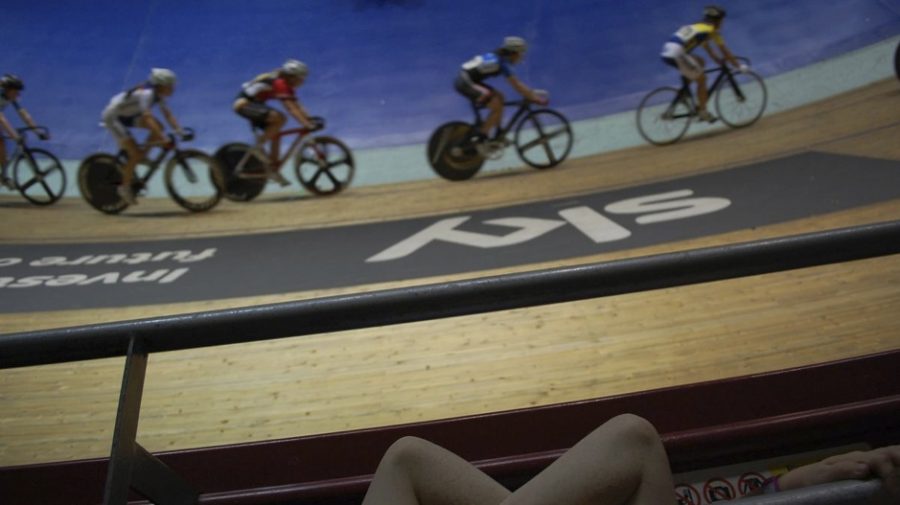
If the banking looks steep from the bottom, it look like a sheer cliff from the top, like riding a wall of death – Image ©Paul Harris
One thing that you DON’T really hear is how much the camera slows things down, too. When I got there in the afternoon for Revolution 39, there were riders casually spinning around before the National Madison Championships, in groups and individually, fresh-faced youngsters and crusty old seasoned pros alike. Their pace was pretty impressive, even just as they warmed up, but my attention was seriously grabbed a few minutes later – without me really noticing, the composition of the riders changed subtly. The traffic slowly thinned out, and instead of groups going round at the bottom, chatting and practicing the odd changeover, all of a sudden it turned into stocky fellers, circulating slowly and silently on their own, high up on the banking. I happened to be sat facing the track when their purpose became clear – with no warning, a dark blue streak arrowed across my line of vision almost too fast for my poor unprepared brain to track. There was no sound in advance, and you could almost feel the whump of the air being forced apart by the speeding rider – the sprint guys, out for a final tune up before the heats that afternoon. I don’t want to exaggerate – they weren’t faster than a speeding train, or so fast they were blurred, but if you’ve never had a sprinter unexpectedly go past you at speed close up before, trust me on this too: it will make you sit up sharply and utter an involuntary expletive.
A couple of other things surprised me early on – the first was how small the arena as a whole is. With a capacity of around 3500, the National Velodrome can only seat about 6% as many people as the City Of Manchester Stadium over the road. The second was that it wasn’t sold out for the National Madison Championships. It wasn’t empty by any stretch of the imagination, but I would estimate it was only between half and two thirds full, which is an absolute crying shame not only because the racing itself was superb from start to finish, but also because tickets were just six quid – for £6, those with the foresight to be present got to see the likes of Fostermann, Hindes, D’Almera and Pervis in action during the early sprint rounds, they also got both Boys and Girls rounds of the DHL Future Stars Madison, and the race for the first National jersey of the year. Six quid – they should have been queueing ten deep at the doors!
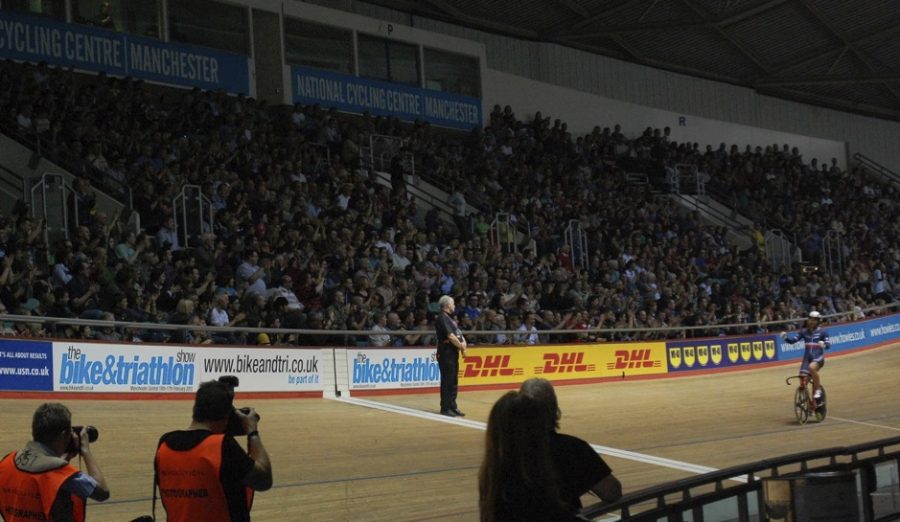
Pervis’s sprint win was warmly welcomed – it was to the credit of the knowledgeable crowd that away team wins were so readily applauded as home victories. – ©Paul Harris
The Madison itself was an incredible race, going right to the wire after a smidge under an hour’s racing, and there was a wait of an hour or two between that and Revolution itself – and when that started, you couldn’t have got a seat for love nor money. The quality of the competition was absolutely top draw – even when there was a “favourite” for an event, it was by no means certain that they would win, and frequently they did not. Spurred on by the world-class racing, the crowd were vocal and enthusiastic all night long which really added to the atmosphere, and one aspect of that that I was really pleased about was that it wasn’t just people cheering for the home riders –when one of the less-fancied riders, or a rider racing for France or the Rest Of The World won, even if it was a British rider they beat, even one of the stars, the crowd stood and cheered the performance. Pete Kennaugh’s astonishing ride in the Points race drew plenty of praise, of course, and was a hugely popular win – but the crowd cheered just as loudly when Robert Bengsch and Marcel Kalz smashed the kilo Madison TT field apart like a well-aimed bowling ball scattering the pins to all corners. I really liked that lack of jingoism.
Was there a downside? Not that I can think of – only that tickets are hard to come by, but the series can’t be faulted for being a successful draw. The only thing that I did come away thinking was, I wish I could have a go – but then, having said that, a handful of brave and hardy souls took to the boards for a taster session between the afternoon and evening events when the velodrome (thankfully for them!) was free of spectators. And watching them gamely spin round, another thought occurred – the gap in talent and ability between the national pro and the keen amateur man in the street is a gulf so vast as to be virtually insurmountable. They make it look easy, the pros, they really do – that’s another thing the camera doesn’t show you. Would I go again? I can’t wait for the next one…
Revolution is a brilliant evening, it’s truly action packed you don’t get a moment to blink. The Manchester Velodrome is an amazing venue and now contains a BMX Park. The seating is comfortable, the Velodrome staff are the friendliest you’ll come across at a sports venue, even the guys stood out in the freezing cold directing you into your parking space have a smile and a joke for you. The car park is well organised but if you are attending an event you do need to check the Manchester City Football fixtures beforehand as the velodrome traffic can get caught up in the Football queues as the stadiums are opposite each other. The Velodrome is very well signposted from all sides of Manchester.
Food at the Revolution is ok, there are a couple of nice kiosks that sell good coffee and pancakes, but most of the food is burgers and hotdogs, the queue’s tend to be huge, if you’re travelling a long way I would suggest eating before or taking something with you, there is a large supermarket next to the venue if you get stuck. Ticket prices are excellent, sporting events tend to overcharge but the Revolution and most other cycling events held at the National Track Cycling Centre are peanuts in comparison, it only cost £6 to attend the National Madison Championships in the afternoon! Revolution will set you back between £10 and £20 for a single standard ticket but discounts are available for family tickets, carers and pensioners, season tickets are the best buy, you get a British Cycling early bird ticket buying option if you’re a member. If you want to get up close and personal with the riders and teams then the VIP tickets or Track Centre Lounge tickets are for you.
There are some great stands from bookstalls to cycling brands and some things for you to have a go at including Watt Bikes and Rollapaluza, it would be good to see some more though.
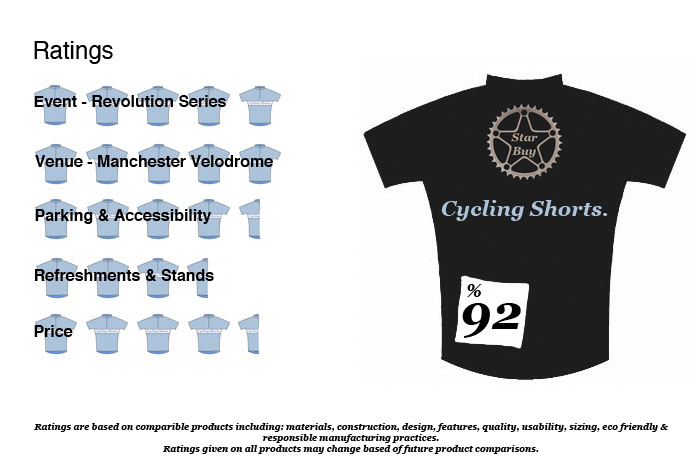
We give the Revolution Series our Star Buy rating!
The next and final round of the 2012 series will be held at The Sir Chris Hoy Velodrome in Glasgow on Saturday 2nd February 2013
For more information on the series visit: www.cyclingrevolution.com
Standard tickets are sold out for Revolution Series Round 4 but Track Centre Lounge and VIP tickets are still available – buy Track Centre Lounge tickets here.
Watch Revolution Series Round 4 highlights on Thursday 7th February at 8pm on ITV4 and catch up in ITV Player
by Anna Magrath | Jan 30, 2013
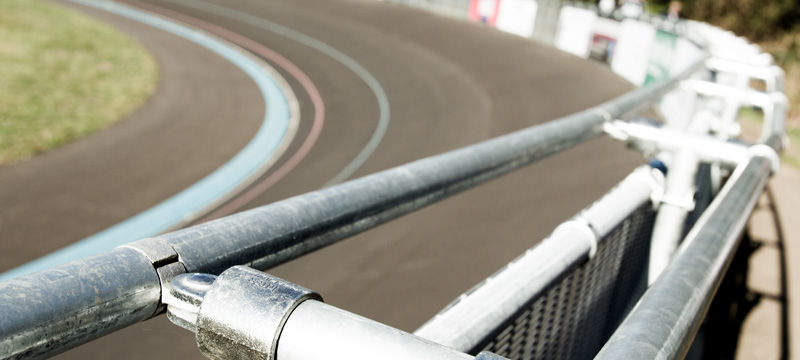
Herne Hill Velodrome Celebrates
Olympic Legacy Project is Given Green Light
Herne Hill Velodrome is one of the finest outdoor cycling tracks in the UK and is the last remaining finals venue from the 1948 Olympic Games. Much of the UK’s Olympic success in 1948 came from two silver and two bronze medals won in track cycling events. It is still used by the British Cycling as a base for developing cycling talent and encouraging grassroots interest; famous names whose careers began at Herne Hill include Bradley Wiggins, Laura Trott and Jo Rowsell.
The Herne Hill Velodrome Trust is the charity established in 2011 to lead the refurbishment and renewal of the Herne Hill Velodrome site for current and future generations of cyclists. The have been working hard to gain recognition of the importance of the Velodrome to the local community and beyond today there was good news….
Southwark Council has approved (subject to conditions) two planning applications from the Herne Hill Velodrome Trust to improve facilities at the historic outdoor track in South East London. The works will be funded by a £400,000 grant from Southwark Council’s Olympic Legacy Project.
The first approval will see construction of an area of hardstanding and a junior track within the velodrome’s inner field. These will provide much needed training facilities for young, novice and less able riders. The junior track will provide a 250 meter flat surface for wide and diverse community use, such as the charity Wheels for Wellbeing who use hand bikes, trikes and side-by-side bikes to help less able riders enjoy cycling. This is the first time Herne Hill will be able to offer such space; other than the track and mountain bike course, there is currently no tarmac area for new and young riders to practice.
The second approval will see installation of much needed track lighting on the main velodrome, the first time the track has ever been lit in its 122 year history. The lighting has been designed with bespoke lighting poles to ensure it delivers the required brightness whilst also minimizing light overspill and with no ecological impact. Lighting will be available for use up to 9.15pm and will allow the velodrome to be used during the winter months when early darkness currently prevents training.
Chair of the Herne Hill Velodrome Trust Hillary Peachey said: “This is a very proud moment in our campaign. We will be able to offer more children, from more diverse backgrounds, an opportunity to learn track cycling. There will be more sessions for women to take up riding, and more time for non-conventional and less able cyclists to discover the freedom of riding in a safe and welcoming environment. And we can at last offer better facilities to those elite riders who train and race at Herne Hill, inspiring the next generation.”
Ian Drake, CEO of British Cycling, said; “’We are delighted that the Herne Hill Velodrome Trust have been successful in obtaining planning permission for what is effectively phase two of the velodrome’s rebirth. Phase one was achieved in 2011 when British Cycling resurfaced the track, saving it from closure and we look forward to working with the Trust, the Dulwich Estate, Sport England and all our local members and supporters to deliver phase three – the redevelopment of the pavilion”.
Cllr Veronica Ward, Cabinet Member for Culture, Leisure, Sport, and Olympic Legacy at Southwark Council, said: “The Capital Legacy Fund has contributed significantly to the development of this famous Velodrome. We are delighted that this next phase has been granted planning permission and that the energy and dynamism of the 2012 Olympics has not been lost in Southwark. We are already seeing real examples of a long-lasting legacy. The state of the art improvements at Herne Hill Velodrome will open up this fantastic facility to larger numbers of cyclists, and allow different generations and people of all abilities to take advantage of the activities on offer.”
Michael Conway, CEO of FM Conway who have been contracted to complete the works, said; “We are extremely pleased to be involved in these prestigious works and are looking forward to working on this historic site that has played such an important part in our sporting history.”
Approval of the applications coincides with preparation for the biggest event of the year at Herne Hill, the Southern Counties’ Cycling Union Good Friday Meeting. This event is now in its 110th year and will be held on 29 March, 2013. With the date looming, and international riders as well as British champions already booked to race, the timing of being granted planning permission and being able to begin work on site could not be more important.
The construction team are fully committed and working hard in uncertain weather conditions to enable the completion of the infield works in time for Good Friday. The installation of lighting will follow in May.
The project team are:
Jackson Coles LLP – Project manager
Hopkins Architects – Feasibility study
Rolfe Judd Planning Ltd – Planning consultant
Deloitte LLP – Cost Consultants
Ramboll – Structural Engineers
Peter Deer Associates – Services & Engineering
Freshfields Bruckhaus Deringer LLP – Legal representative
Spokesmen Ltd – Public consultation & media
FM Conway – Contractor for works & project partner
by Lawrence Bywater | Jan 23, 2013
Hopefully this will add something to the great article written by Tony here.
Last week was tough for cycling, hitting the national headlines for all the wrong reasons. Yet help was at hand with the start of the pro tour season in Australia and Argentina and perhaps even more exciting; 4 days of the London Bike Show to cheer even the most cynical of fans.
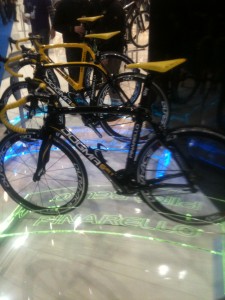
Bradleys Wiggins’ Pinarello Dogma in Malliot Jaune Livery
Having never been to an event like this before, the first thing that struck me was the sheer number of people in attendance. OK, tickets included entry to three additional shows within the Excel but the exhibition centre was positively throbbing. As the glitz and glamour of Wiggo mania wanes it was heartening to see continued excitement surrounding cycle sport in general.
Kudos goes to the new Madison Genesis team, managed by ex Garmin-Cervelo rider Roger Hammond, who held their team presentation on the Saturday of the show. Hosted by the delightful Ant McCrossan it was a chance to see some of the team’s extremely youthful looking riders like Alex Peters and Brendan Townshend which have combined with elder more experienced riders like Dean Downing, Ian Bibby and Andy Tennant.
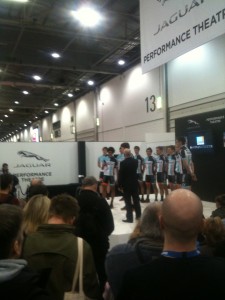
The Madison-Genesis Continental Team being presented on stage
Arguably the most interesting aspect of this team is their promotion of the Steel framed Genesis Volare bike. Equipped with a Shimano Dura Ace and Pro finishing kit, the team bike is a delight aesthetically. Extremely classical, yet with modern touches. The downtube is wider than traditional steel bikes pandering to the modern trend for oversized tubing.Indeed the team is making a big deal out of the specially developed Reynolds tubing made in Birmingham.
The prevelance of Carbon Fibre as the go to material for high end road bikes may yet be challenged and as Genesis themselves argue; they have looked to banish those 80’s misconceptions that Steel frames are heavy flexible steeds. Instead, suggesting that they have combined the durability and comfort that is usually associated with a steel frame, with the race weight and stiffness of modern bikes.
Bibby, Downing, Jack Pullar, Chris Snook and Sebastian Baylis proved the bike was no slouch when they took part in the Elite Men’s Criterium after the presentation. The speed of the peloton around the tight, twisting 500 metre indoor circuit was astonishing to watch. With Bibby coming out on top beating UK circuit regular teams likes IG-Sigma Sport and Hope Factory Racing Team it was the perfect start for the new team. The folding bicycle race was also great to watch as a prelude to the main criterium. The ‘Le Mans’ style start meant that riders had to unfold their bicycles before setting off. Keith Henderson’s huge, race winning attack on the penultimate lap was very impressive. The Animal Bike Tour with Martyn Ashton, Blake Samson, Luke Madigan and Billy Atkins was also a joy to watch. Whilst Ashton was undoubtedly superb, Billy Atkins at the age of 17 pulled off some outrageous tricks on a scooter.
Elsewhere at the show you could not move for visual delights. Cervelo, Pinarello, Willier and Specialized all in attendance. Yet what struck me in
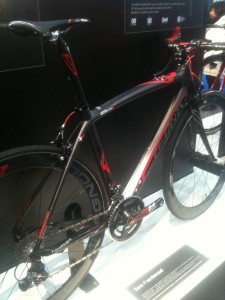
Stealthy looking Wilier
particular was the range of bike brands on offer. Canyon, Team and Time amongst others. Canyon in particular were exhibiting a range of road and MTB frames all at varying price brackets. The Ultimate CF was a particular delight with perfect geometry and presence at a great price, along with Joaquim Rodigruez’s Giro d’Italia customised Aeroad CF lavishly decorated with pink decals to match the Maglia Rosa he spectacularly lost to Ryder Hesjedal in 2012. This spectrum of bikes although dizzyingly confusing can only be a good thing for the continuation of top end cycle sport. And with the news that Pinarello is looking to stock frames at selected Halfords stores, we are now more than ever, spoilt for choice.
Amongst other products on show, Nanoprotech was perhaps the most innovative, like nothing I’ve seen before. Whilst Sportful where exhibiting an extremely lightweight waterproof jacket. Hope continue to produce beautifully engineered bike products, contact points and accessories whilst Schwalbe’s extensive range of tyres was mind boggling. Last word goes to Clif Bar whose Builders Bar was very tasty in a variety of flavours along with their electrolyte shot in Citrus and double espresso was easy on the palette.
by Hayley Davies | Jan 23, 2013
I was delighted to receive two tickets to the London Bike Show last weekend and rather gutted to find out I couldn’t go. As an ex-pro who still cycles every day, my Dad was of course, more than happy to pop along. Here’s Tony’s account of the bike show on Saturday…
*****
The moment I stepped off the Docklands Light Railway on Saturday morning I knew it was going to be busy. The snow that had fallen copiously in the London area the previous day meant I had to use public transport although I have never been totally comfortable travelling on a driverless train and leaving everything to a computer. I had assumed that the weather would keep a lot of people at home but I was so wrong. The masses propelled me towards the entrance and looking around at my fellow visitors I couldn’t help but notice how well prepared they were for bad weather with a good selection of beanie hats, stout boots and several in what appeared to be rubberised jackets. All was to become clear.
The queue at the entrance was at least 50 deep but moved quickly. My ticket was snatched away and I found myself inside the ExCeL centre – but oh no, the overhead banner proclaimed “Welcome to the London Boat Show”! My inner chimp panicked, how would I retrieve my ticket and get back out? Then I heard someone say “the Bike Show is in the hall at the end”. Tickets gave access not only to the Bike Show but also to the Boat Show, The Outdoors Show and the Active Travel Show.
It wasn’t yet 11 a.m. but it appeared that the Bike Show was drawing in well over 25% of the visitors and so my slow shuffle down the first isle began. The sheer volume of people attending in such bad weather is a fine testament to the popularity of cycling, however, on this occasion it did make it difficult to have a chat with stand attendants.
Even though progress was slow, what struck me straight off was the number of stands showing complete road bikes for sale. Pinarello had the largest stand, right in the centre, displaying a wide range of complete bikes from entry level sportives at around £1,000 to their top end time trial machine coming in at £14,000. If you can only manage £11,000 then you can pick up a nice little track number. Boardman was also there in force at the far end, close to the Animal Bike stunt track where Martyn Ashton (four times British Bike Trial Champion) and Blake Samson were performing mind boggling acrobatics and aerial manoeuvres.
I know I’m an oldie, and call me old fashioned if you want but much of the roadie’s off season pleasure used to be gained from reviewing and selecting the various components that were to be built onto the coming season’s new frame. Now the pressure of volume production versus price directs most of us towards pre-configured complete bikes built around a mass produced monocoque carbon fibre frame, 99% of which are manufactured from one of four or so factories in the far east using carbon fibre spun from one of three Japanese facilities, Toray, Toho Tenax and Mitsubishi Rayon. Time and time again I asked where the vendor’s frames were produced and got the same answer. At Canyon Bikes I asked again if their frames were made in China? “No” the proud German lady proclaimed, I was momentarily excited – perhaps it would be Dusseldorf or Nuremburg, but alas “….ours are manufactured in Tie-van” (she meant Taiwan)!
I could only find three suppliers displaying custom carbon frames. Sigma Sport were offering a hand built custom carbon frame from the iconic Italian Colnago house using preformed carbon lugs bonded to the tubes. I was told Signore Colnago strongly believes this is the right way to do it. You would need £3,000 or more to have one made to measure but I can’t help thinking that these are like giant Airfix kits – preformed pieces glued together and very quick to assemble, although I must admit the multi-stage hand paint process is fabulous.
Le Beau Velo, distributor for the Italian Fondriest brand were offering a bespoke carbon fibre ‘layup’ frame, where the joints are held together with cut-to-fit carbon fibre sheets bonded with epoxy resin rather than preformed lugs. I was told no UK fabricator does this. These frames are hand made in Italy and again have a price tag north of £3,000. Their tubes are constructed from Toray carbon fibre from Japan but they claim the actual manufacturing of the tubes is performed in Italy, presumably by ATR who also supply Colnago and are one of the very few non-Asian manufacturers of monocoque frames. Equally as strong, stiff and responsive as a carbon monocoque, Le Beau Velo’s typical custom frame customer is a gentleman of a certain standing who can afford something that looks special…that is special, whilst still young enough to ride to its full potential (or most of it anyway), “a top end racing frame that is seldom used for racing”.
The Extra stand was also displaying carbon lugged frames manufactured by Time. Time is a French company who obtain a lot of their revenue from contracted carbon fibre work at the Airbus aircraft factory in Toulouse. This has enabled them to become another of the very few non-Asian manufacturers of carbon fibre weave, although their volume in comparison to the far east manufacturers is very small and the number of frames they produce is also small in comparison.
Independent steel and titanium frame builders were noticeable by their absence and I saw only a handful of non-carbon frames for the serious rider. There was no Bamboo construction in evidence at all, which is surprising given the ‘green’ momentum these fabulous machines have been getting. Perhaps the cost of renting a stand at the show is prohibitive to all but the largest suppliers and distributors.
One final note; I happened to be ushered by the masses out of an isle just in front of the Jaguar Performance Theatre as the newly formed professional team sponsored by Madison Genesis was being presented (video below). First up was Dean Downing followed by 8 or 9 fresh faced professionals all hoping to be part of this year’s UCI Continental team under Roger Hammond’s stewardship. They also announced that Genesis has been working with Reynolds to develop a new ‘953’ steel-alloy frameset.
Overall, a hugely enjoyable and educational experience, if hampered a little by the sheer volume of visitors. I stopped on the way back to meet my wife at the newly built Westfield-Stratford shopping mall. It was empty by comparison!
Writer
Riding since Feb 2011 Hayley is a 30 year old female who loves adventures. If she’s not on one of her many bikes or in the water on a bodyboard/surfboard, then Hayley is probably out looking for something new to keep the adrenaline pumping!
Website: www.hjdonline.co.uk
by Paul Harris | Jan 15, 2013
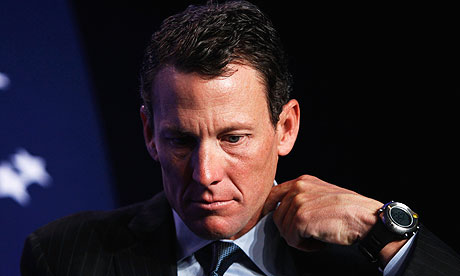
Photograph: Lucas Jackson/Reuters
Now this brief interlude – musings on Lance before the soap Oprah starts
I’ve been a staunch and vigorous supporter of Lance Armstrong since It’s Not About The Bike came out – I remember hearing sports stars raving about this must-read book, so I read it, and I raved about it too, and I made as many people read it as I could. Even back then there were rumours on message boards that maybe things weren’t as clear cut as they might be on the surface. As a general rule of thumb, I was an Armstrong groupie – I didn’t follow cycling, but brother, believe me; if you were going to start casting dark aspersions on the validity of Lance’s triumphs, I was going to be on your case.
So he won, and he won, and he won, and I was happy every time I heard about it for this remarkable man and his Hollywood fightback from the edge of the abyss. Occasionally people would say things, and I’d sneer – “he’s the most tested athlete ever,” I’d say. “And he’s never failed a test. He’s been through chemical hell – why would he ever voluntarily do it to himself?” You don’t need me to run through all the clichés, they’ve been around for a long time and you’ve heard them all before.
Lawsuits and accusations kept coming, and he kept fighting them off, and every time he won, it vindicated the truth I thought I knew. When the USADA story broke, I shook my head sadly and said to myself – “when will they ever let it drop?” Even when it was announced that he wouldn’t be fighting the charges, I still felt I stood on solid ground – they’ve finally done it, I thought, they’ve worn him down and won a meaningless victory. I felt sad for him and angry at USADA – it was like they’d been hunting this beast they feared, and when they finally caught it, I was 100% convinced that the coup de grace would show them that they’d caught nothing, a Lance into the side of an empty balloon.
So when the “reasoned decision” was released into the public domain, I snorted with derision and awaited the riposte, for surely there must be something coming – I couldn’t imagine that a man with his drive, integrity and will to win would just walk away from the fight, even if he wouldn’t put up with any more courtroom battles. There had to be something, some killer statement, some undeniable evidence that would blast USADA out of the water and end the argument for good. I knew there had to be some killer blow waiting to fall on the quivering necks of all the suits to put them out of their misery!
So I sat back with a grim smile and I waited. And I waited and waited. And nothing came out, there WAS no comeback, nothing more than fragile statements. And every day that passed, I felt the earth beneath the foundations of my Lance faith begin to grow weaker, and start to slip. And then I took the time to read the Reasoned Decision, and my little castle of faith crumbled to dust on the floor.
And the barmy thing is, I still don’t think I really feel angry about the duplicity. It’s like the “say it ain’t so, Joe” story – an apocryphal tale, maybe, but I’ll tell you now, that’s exactly how I felt; not angry, I didn’t crave justice. I just felt saddened to the core that something I held so dearly was shown to be a falsehood. I didn’t want Lance to be a villain – I had too much invested in him being the hero.
As I write, the Oprah interview has been filmed, we are two days away from the showing of it, and rumours are already floating about on Twitter about a confession. For my money, what I can’t work out is motivation – ostensibly, Lance wants to speak publically in order to be able to race again, triathlons and other endurance events. Is it going to be a confession? I don’t see how it could be otherwise – surely any attempt to continue the delusion would finish him for good. So – what else is there for him? I can see it going one of two ways – either it’s going to be a soft-peddled “I had to because everyone was doing it” flavoured confession aimed at winning the favours of a passive, non-specialist audience and keep hopes of his rumoured desire for a political career alive. Or maybe he’s going to properly tell everything – no holds barred, and let’s clean this sport up.
I would be disappointed with the first. I think it would fulfil the expectations of a public and cycling world that is rightfully cynical, and the only people who might soften their hearts to him are people whose opinions aren’t worth a huge amount to the cycling world. But what could he achieve with the second? If he names and shames other dopers or complicit members of teams or governing bodies, or at least makes it clear that that is what he’s going to do, then he will at least have done what he can to right the wrongs of his past. Redemption is too much to ask for, I think – he’s guilty of too weighty a burden to make that step, and I think the talk of returning to competition is a pipe dream at best. What I hope is that he has a conscience, that he wants to try and lay his own demons to rest, and that in his change of heart he does everything he can to identify culprits and – more importantly – uses his knowledge to work towards stopping the use of PEDs in sport, a la the remarkable David Millar. Unlike Millar, for Lance redemption might not be achievable, but that doesn’t mean it can’t be worked towards.