by Heather Bamforth | Mar 8, 2013
On Sunday 3 March 2013, at an industrial estate just outside Skelmersdale, Lancashire, 37 ladies lined up for the start of the first round of the inaugural Cycling Development North West’s (“CDNW”) women’s road race league.
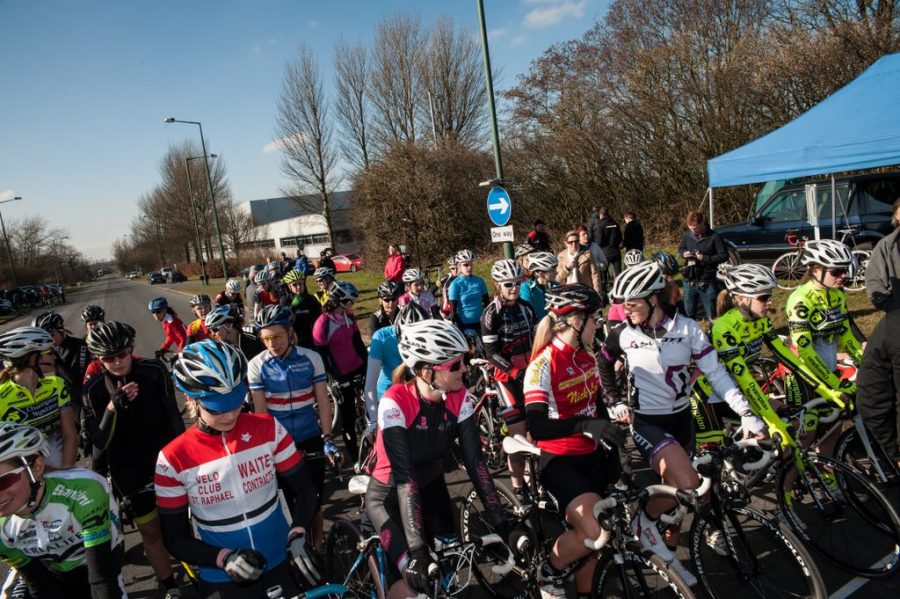
Start Line at Pimbo
That figure, to many, may not seem astounding but there are two facts that must be remembered in order to consider this fully. Firstly, when the men’s road race league was set up 10 years ago, the first event had just 10 riders. Secondly, the number of riders who lined up in the event on Sunday included nearly a third who were experiencing a road race for the first time – for some it was their first event on the open road (having just raced on closed circuits previously) and for others it was their first foray into either competitive cycling or bunch racing, with quite a few riders making the switch from time trials and triathlon to road racing.
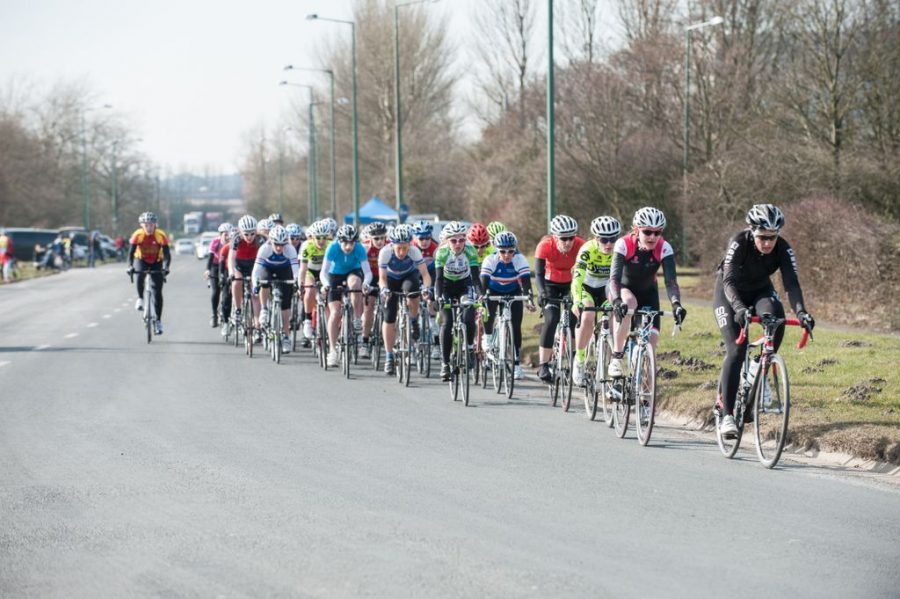
Competitive racing was had throughout
I can’t lie. I was quite emotional when I arrived at the headquarters. We knew that we had to get at least 15 women to break even, so I have worked hard since October to spread the word through social media. I think it has worked – I have just populated the results for the league and we have 50 riders registered – a far cry from the 10 that we were told to expect.
But it gets even better – there are many sceptics out there of women’s racing – it can be negative and there have been some comments about bad riding – but the event at Pimbo was testament to the quality of racing that professionals would be proud of – there were heroic attacks, team tactics and a bunch sprint, all of which did not fail to impress the officials and spectators.
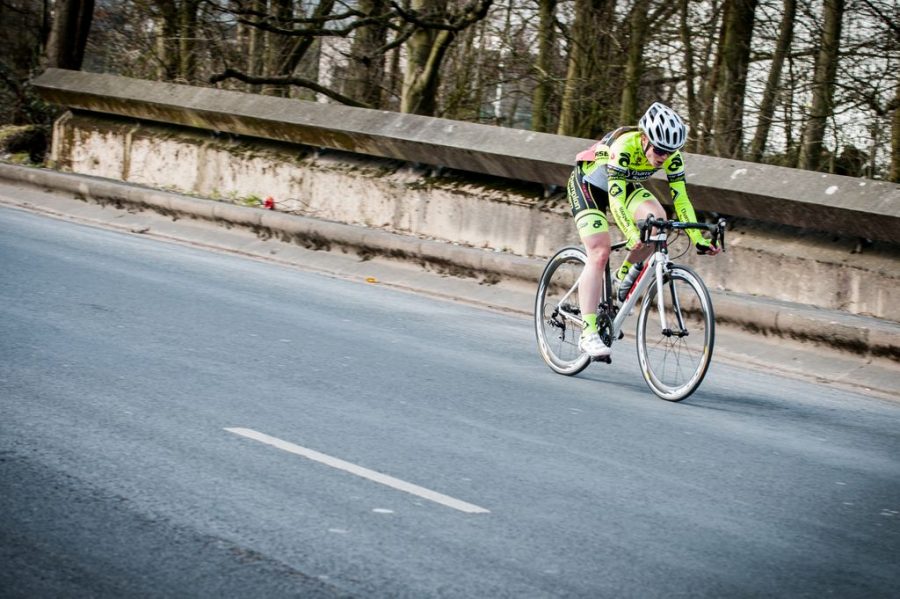
Jo Blakeley of Champion Systems/Maxgear Racing on the attack
Every single girl who turned up to Pimbo on Sunday should be proud that they were part of hopefully the start of something very special in women’s cycling. This is the only road race league for women in the country where all events are road races (no closed circuit races or time trials) and my only wish is that the girls who competed on Sunday keep it up – the CDNW women’s road race league is just that – a league – with all events counting towards the main league title. Everybody who finishes an event gets counting points towards the league.
It’s an exciting time to get involved with women’s competitive cycling. Can you afford not to get involved?
The next event is on 17 March 2013 at Pilling, Lancashire. There is still plenty of room for any second, third or fourth category ladies to enter. Please visit www.cdnw.org for more information.
Thanks to Ed Rollason for the photographs.
by Annie Simpson | Feb 26, 2013
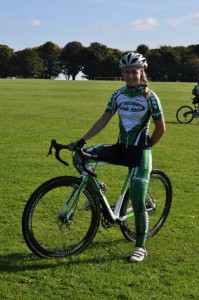
Cyclocross Season
For me the Cyclocross season ended in January. With my road form, of which I had desperately been trying to cling on to, long gone and little time to train around racing I finished the season a detrained, demoralised poor excuse of a bike racer. After a few days (or could of been a week) of eating every bit of cake, chocolate, biscuit or any variation of baked goods I could get my hands on, I gave myself a metaphoric slap and decided to buck my ideas up and look ahead to the 2013 road/mtb season. After perusing the Racing Calendar I had put together a tidy competition plan for the year, gave myself a pat on the back, had some celebratory cake, then looked at the dates….Panic immediately set in. My first race was NOT that far away and with new shiny kit and even shinier bikes I really did need to pull my finger out and get fit quick. Like most people I have limited time as I am in Uni 5 days a week, but sadly it’s not doss (undergraduate) Uni anymore I have been there done that, no now it’s a time consuming Masters degree with an added 20 hour per week Nutrition Internship.
And so here I bring you the Annie Simpson Guide to get Fit Quick! It is none scientific, not wholly sensible and at times very painful but as I sit here a week out from my first race of the season…I think/hope it worked.
1) There are no 2- ways about it, you need to tolerate the Turbo! Even if you don’t want to turbo, you should probably just man up and get on the turbo. I found even grabbing as little as 45 minutes here and there is better than nothing. But NEVER just ride, because a) that’s boring and b) it needs to feel worthwhile i.e Hurt. So just come up with some crazy pyramid session that requires a lot of clock watching, so much that you start willing time to slow down for the recovery sections. I never really have any rhyme or reason to what session I do, I just do what I feel like to increase the odds of actually getting on the dreaded thing.
Dani King- Current Olympic & World Champ!
2) When you do have time to ride outside for a decent period of time, ride with people who are infinitely better than you. This will give you the harsh wake up call/ kick up the bum you need to just get better!! My personal example of this comes in the form of one day me deciding it was a good idea to go for a long ride with current Olympic and World Champion Miss Dani King. Needless to say, I got an absolute kicking. And just for good measure, Laura Trott also made an appearance on said ride and proceeded to drop me as she rode easily up a climb. To cut a long and torturous story short, I blew so bad, so so bad that Dani had to physically push me home! No word of lie, I had blown so bad I had lost my sight and my legs would no longer turn, I even threatened to end our friendship! Thankfully she took me out for a posh burger in Hale and huge serving of Fro Yo and we can now remain friends. Moral of that story: It was a rude awakening and actually gave me a whole load of motivation to continue to get fit quick, in a sadistic kind of way.
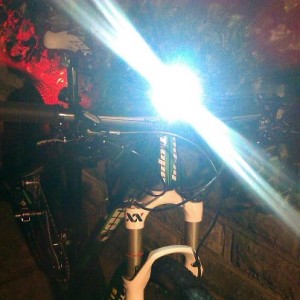
Night Riding!
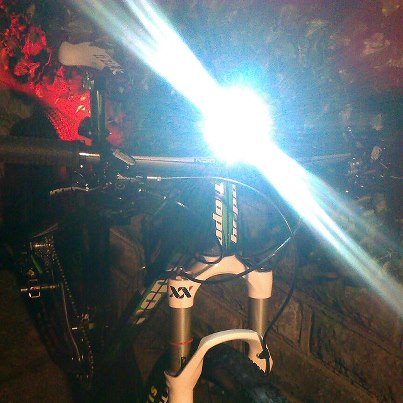
3) Do not be afraid of riding in the Dark! It actually is surprisingly motivating as it gives you the sensation that you are riding very fast, that is until you look down at your speedo and see your not, therefore remove said speedo and morale will be considerably higher as you still think you are riding very fast! Good lights help, it’s worth the investment (Shameless plug: Hope Tech lights are the best). Especially if you are going MTBing in the dark, I have found you end up hurling yourself down stuff that if you could fully assess in the daylight then you might not attempt, therefore it doubles up as technical training too, Bonus!
4) I don’t have the time or the money to go get all buff in a gym, or also known as S&C. Don’t get me wrong I would like too, but it just doesn’t fit. So I have developed the Living room Gym! Ever get the urge to break into a lunge or squat? No me either, but if you just force yourself to do it 2-3 times a week I have found its better than nothing. Just using your own bodyweight is a good place to start, but then as you progress start holding household objects such as big books, bags of sugar or the less weird option of mini dumbbells. Do planks & push ups and if you’re really getting into it do some stretching at the end and there you have a little step into being a little bit better. It’s a bit like that Tesco advert ‘Every Little Helps’ a budget workout!
5) During this cold weather we have been having… then not having… then having again, I have made some huge kit misjudgments which I now believe may have worked to my advantage. For example, wearing less kit makes you cold and therefore to warm up you must ride faster. When you get 70km from home on the club run, you are frozen, you reach into your back pocket to put on your cape, the cape zip does not work, you remain frozen! The club run sets off back at a blistering pace, due to having less kit on I found I was more inclined to chew my stem, dig in and not get dropped as a) I was actually starting to warm up & b) I would get home and out of this god awful weather a hell of a lot faster.
There you have it! I must stress these are by no means recommendations, if I had the a bit more free time I would do things a lot differently, but you have to play the cards you are dealt. It remains to be seen what my season holds off the back of ‘that’, but thankfully I have an up and coming training camp in Majorca to do some proper training. I will let you know how it all goes.
Happy Pedalling!
Annie (@LittleSimo)
by Nick Dey | Feb 25, 2013
Cycling Turbo Training for Beginners
a quick start guide to cycling indoors to explode your fitness fast. (20 interval workouts included).
by Rebecca Ramsay
Reviewed by Nick Dey

Cycling Turbo Training for Beginners is written in no-nonsense, ‘does what it says on the tin,’ prose and offers the novice indoor cyclist – of whom there has been an exponential population explosion this delightful winter – plenty of valuable and pragmatic advice on how to, as the Amazon Kindle page Amazon Kindle page
states,
“get you up and running quickly and efficiently with turbo training so you can maximise your fitness when you can’t get outdoors for cycling training.”
The guide begins with a useful introduction by Rebecca and succinctly contains her raison d’être; the essence of which is to help those cyclists who feel intimidated and overwhelmed by the prospect of indoor cycling, offer a purpose to their turbo training and, not least, to inspire them to give the turbo a prolonged go (not just a session or two!)
The book begins by addressing the obvious in Section 1: what equipment do I need for Turbo Training? It covers pretty much everything from the Trainer + your bike (and tyre) through cadence, heart rate and power and onwards to hydration and the use of towels. If you can think it then be reassured, Rebecca has probably covered it. I’ve been using a Turbo for a year or two and still picked up many instantly useful tips.
Section 2 asks the question: What is Turbo Training and why bother? A short section that dispels a few myths and sets the agenda for what follows which is Section 3: Where is best to Turbo Train? Section 4: How do I go about an effective Turbo workout? Is where Rebecca’s experience as a professional cyclist really comes into play. She covers, with justifications, the warm up, the work out, including intervals training, and the cool down. If you think the latter unimportant then look at how many teams are now mimicking Team Sky’s approach (which they themselves introduced from the world of swimming.)
Section 5 hopes to help you overcome the perennial gripe about Turbo Training: 10 Ways to overcome Turbo Training boredom. It is condensed and thus easy to access and contains much that may help all cyclists, irrespective of experience. As does the oft neglected section 7: recovery from Turbo workouts!
So, now you’re familiar with the fundamentals it’s time to choose your Turbo Trainer and section 7: Which Turbo is right for me? Will help you make a reasoned choice, without any insidious marketing hype. Rebecca has ridden many trainers and reviews them without obvious bias, although she does have her favourite(s). What about rollers, I hear you ask? Well, section 8: Rollers versus Turbo Training – which is best? Sheds some light onto the debate and clearly explains the pros and cons of each system.
Ok, you’ve made your purchase and are now rearing to ride. Section 9: understanding pedalling technique and cadence, presents a vital, and sometimes omitted aspect of the sport. It is here you get a taste of Rebecca’s depth of experience and her workout paradigm, that of the structured interval, through a suggested cadence workout. It’s very good, I’ve tried it.
The book closes with a sack full of really well planned and explained Turbo sessions: Section 10: 20 Turbo charged workouts to explode your fitness! It starts with beginners intervals and progresses steadily through various structured-interval programmes: pyramids, negative splits, isolation, crossovers, threshold, power, etc. There is a definite progression here so the novice would be well advised to start with in the lower digits of the workout chronology – many are tough! Simply reading it gives you an insight into how to correctly and usefully structure your training. Riding them will only help you to become a better rider on the road.
An Aside: I notice that Rebecca appears to be using www.trainerroad.com on the book cover to record her sessions. Trainer Road is a superb addition for those of us without a power meter (a review is soon to follow).
This, as Amazon states, is a highly recommended read if you’re new to indoor cycling, or have been turbo training a short while but want professional guidance on how to take your indoor cycling fitness to the next level.
Who is Rebecca and why should I take her advice?
Rebecca Ramsay, nee Bishop, is a former multi-sport athlete: cross country ski champ, international triathlete and international cyclist with elite status who signed as a professional in 1998. She is also a certified personal trainer (NESTA, NCCA accredited).
At present she is a full-time mother of two and is focused on writing on the subject of cycling fitness and training. She also has an active interest in helping mothers become fitter, happier and healthier and plans to write eBooks for this market as well.
Rebecca answers the question – why should I read this guide? I aim to keep my guides short and simple to understand. I know you don’t have time to read a long, detailed science laden cycling book, so I summarise the science and try to give you exactly what you need to know to improve, and I keep the language simple.
If you would like more free cycling training or general fitness help, please visit my cycling website www.easycycling.com. At present on the site I have a FREE 4 Week Winter Training Programme download on sign up to my Ezine.
Additionally, you can find me on my Facebook Page where I’d love to hear from you!
Rebecca has a second eBook that has just been released, it’s available for the Amazon Kindle: The Time-Starved Cyclist’s Training Formula: how to find TIME to train for 100-miles – and NOT get divorced!
A review of this will follow shorty on Cycling Shorts.
CyclingShorts Rating: A real help for the busy novice – and not so novice – ‘indoor’ cyclist, we give it our Star Buy status giving it 100%…. you can’t fault it!
Title:
Cycling Turbo Training for Beginners – a quick start guide to cycling indoors to explode your fitness fast. (20 interval workouts included).
Author:
Rebecca Ramsay
Available for Kindle
Price:
RRP £1.99 (Digital)
by Heather Bamforth | Feb 23, 2013
In advance of the Salt Ayre Spring Series at Lancaster (9th, 16th, 23rd and 30th March – 4th cat men at 13.30, Women only at 13.30 and E/1/2/3 men at 14.30) Salt Ayre Cycling Association are holding novice training on the circuit on 2nd March at 12.30 to 15.00.
If you want toimprove your confidence or just learn the corners on this circuit please come along, all are welcome.
Please note that this is not a race, it is an opportunity to practise your technique (including cornering) and your bunch skills.
Cost is £1 toward circuit hire.
Any queries contact Nev Pearson on [email protected]
by Heather Bamforth | Feb 20, 2013
If you’ve seen my recent articles, you will know that I am trying to encourage women with their first steps into racing. Well this article is about an organisation that has been doing that since 1949 – Manchester & District Ladies Cycling Association (“M&DLCA”). And the good news for women starting out in cycling who may not yet be certain which club they want to join but still want to have a bash at time trialling, well you can join the M&DLCA as an individual, which will then enable you to ride time trials as an M&DLCA member – good, eh?
M&DLCA Best All Rounder Competition
The organisation runs a number of events, including a Best All Rounder (“BAR”) competition, which is based on performances at events run at 10 miles, 25 miles and 50 miles with the performances being calculated in m.p.h. and the average taken of the resultant speeds. When choosing your counting events, the 10 mile time trial must be one of the events promoted by the M&DLCA (see below). For counting events at 25 and 50 miles, there is no restriction except that it must be on any “J” course (the Cycling Time Trials Manchester division, which are all courses based in Cheshire). Once you have completed your counting events, you just need to submit a copy of the entry form and result sheet to the BAR Secretary before 1st October of the current season.
This BAR competition is a great way to try out time trialling, as the women’s British BAR uses 25 mile, 50 mile and 100 mile events as counting events, which could be a step too far for people new to time trialling.
The winner of the M&DLCA BAR holds the B.S.A. Best All-Rounder Trophy for one year and receives a medal. Medals are also awarded for 2nd, 3rd, 4th, 5th and 6th places and certificates to remaining qualifiers. There is also a team event, with the winning Team holding the B.A.R. Team Shield for one year and each member of the winning Team also receiving a medal.
Handicaps
Yes, this is a genuine phrase for use in time trials. The M&DLCA are keen to encourage riders, and all of their events are “handicapped”. This means that if you have a time for whatever distance you have entered, you will be allocated a handicap time, with the fastest lady being put as “scratch”. For a 10 mile time trial, the scratch time is 17.00 minutes, and the organiser will work out what your handicap time is based on your previous results (for example, I entered one of the M&DLCA 10s in 2011 and my previous best was 28:50 and I was given a handicap of 11:03 minutes, which meant that when I completed the distance in 28:36, my time based on handicap was 17:33, which meant that I was third on handicap).
There is also a Handicap Championship, which is based on your handicap times over the 10, 25 and 50 mile events.
What about age categories?
This is where the M&DLCA is extremely useful – not only is there a championship for schoolgirls (under-16s), there is a BAR championship for Juniors (under-18), which yours truly has won in the past, as well as a Handicap Championship for Juniors and there is a Veterans Championship for ladies aged 40 and over. The Schoolgirl Championship is over 10 miles only, whereas the Junior and Veterans Championships are over 10 miles and 25 miles.
When are the events held?
Hopefully, this is making you think, I could have a crack at that AND win a certificate. With that in mind, you’ll want to know what events are available no doubt. Many thanks to Carol Pardoe for providing this information:
- 27 April – Invitation “10”
- 4th May – “10”
- 1st June – “25”
- 22nd June – Invitation “10” again, and GHS (School age) heat
- 29th June – Open “50”
- 13th July – “25”
These events are only open to women however at the “Invitation 10” events you can invite a man, but you still ride on your own. Your combined times count for the prize. If you don’t know a man to invite, don’t worry as the M&DLCA will pair you up with somebody.
The overall vibe at these events is for everybody to have a go, do their best and then celebrate at the end with a cup of tea and a slice of cake. Everybody is friendly and welcoming and if you are thinking of doing a time trial and you are based near Manchester, I would seriously recommend the M&DLCA events for one of your first. Just remember that you have to enter in advance for time trials, there’s no entry on the day, with the closing date generally two weeks before the event.
For more information, please visit http://www.mdlca.org.uk
by Nancy Arreola | Feb 20, 2013
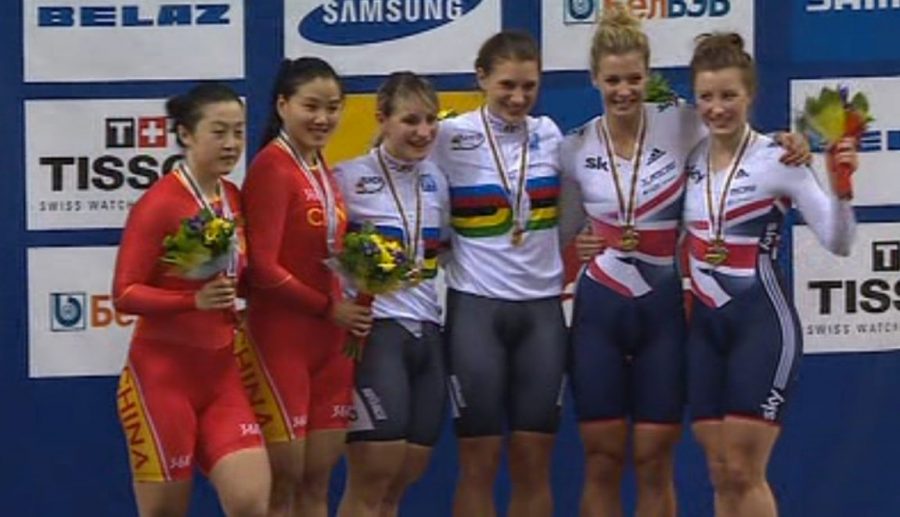
Women’s Team Sprint Podium
We woke up today in a snow covered mornin in Minsk. The trainings prior the race started early at 9am and all the Countries were here with their very best exponents.
The first session began at 1pm while Sarah Hammer qualified 1st in the IP Australia did the same in the men’s TP and we were ready for the opening ceremony and the finals to begin at 6!
The opening ceremony was beautiful they put on an amazing show that was very worth watching until the presidents of belarus and later on the UCI did a very long speach ;)
We were all exciting to see some action and see medals taken, we were so excited that we didn’t mind all the security points that make us wait for hours to get insde the velodrome. But well what can we expect from Russia?
Anyway… the first event of the evening was the women’s team sprint, the German duo of Krystina Vogel and Miriam Welte; are the Olympic Champions but this is a post Olympic year and many riders can surprise us with their form.
Germany and China qualified to fight for Gold and Great Britain against the Aussies for the bronze.
In the men’s 1km Francois Pervis (France) was the fastest followed by Simon Van Velthooven and Joachim Eillers.
The programme was followed with the Women’s Individual Pursuit Finals, Sarah Hammer won in style lapping Amy Cure who secured second while Annet Edmondson was third.
The olympic champions didn’t disappoint, The German girls won the Team Sprint, China was second while Great Britain were third with their new line up.
And then the event everyone was waiting for, the men’s Team Pursuit. This intense competition between Great Britain and Australia that everyone talks about.
But it started with the race for bronze and Denmark came out to beat Spain to take the medal.
And Australia took gold and it felt like a revenge after the Olympic Games.
This is what happened on the first day of competition but there is way more to come!!